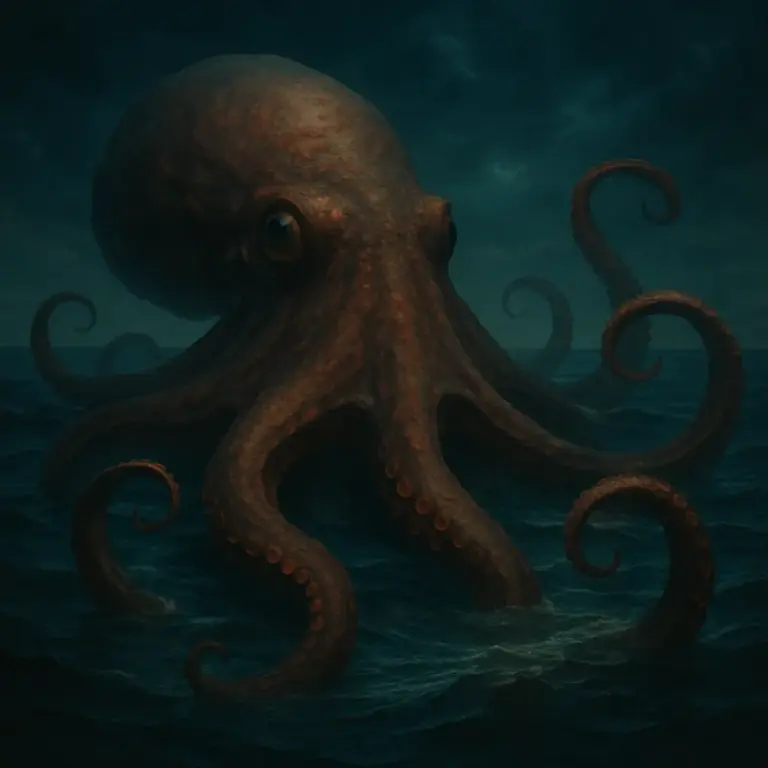
New research reveals that giant octopuses like Nanaimoteuthis haggarti may have been apex predators in the Cretaceous seas, challenging the long-held view of marine ecosystems dominated by vertebrates. These creatures lived about 86 to 72 million years ago during the Cretaceous Period.
The findings indicate that Nanaimoteuthis haggarti could reach lengths of up to 18.6 meters (61.02 feet). Another species, Nanaimoteuthis jeletzkyi, lived from about 100 to 72 million years ago and ranged from 2.8 to 7.7 meters (9 to 25 feet) long.
Fossilized beaks of Nanaimoteuthis suggest they were apex predators, showing signs of intense wear from crushing hard prey. This indicates they likely used their large bodies and long arms to catch prey effectively.
The study utilized artificial intelligence to uncover hidden fossils of Nanaimoteuthis. The research highlights the role of giant invertebrates as apex predators in ancient oceans, suggesting that Cretaceous marine ecosystems were more complex than previously thought.
Yasuhiro Iba, one of the researchers, stated, “This indicates that Cretaceous marine ecosystems were more complex and included a broader spectrum of top predators than previously thought.” He added that these animals represented what could be described as a real “Cretaceous Kraken.”
The powerful jaw structure made of chitin allowed Nanaimoteuthis to process hard foods effectively. However, experts still debate the exact size of Nanaimoteuthis haggarti, with some considering the 60-foot estimate extreme.
The fossils of Nanaimoteuthis were found in Japan and Canada, particularly on Vancouver Island. These discoveries provide valuable insights into the evolution and ecological roles of giant invertebrates during the Cretaceous period.
Jakob Vinther raised an important question: “The question is whether it makes sense for such an animal to prey on such large prey.” This inquiry reflects ongoing discussions about predator-prey dynamics in ancient marine environments.
About The Author