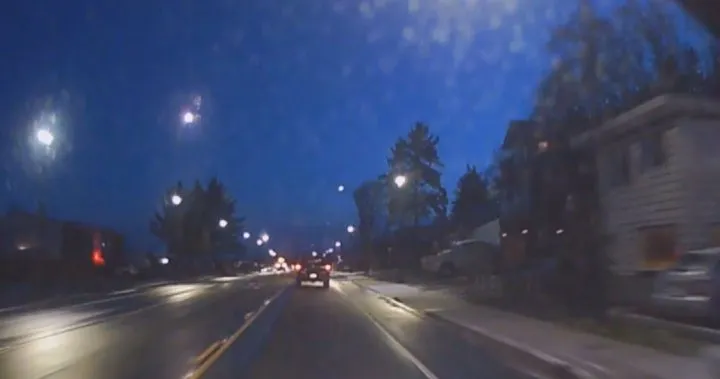
A bright fireball entered the atmosphere above Vancouver Island at 07:12 UTC on April 29, 2026. The fireball was first visible at an altitude of 90.6 km (56.3 miles) above Oktwanch Peak. It traveled southwest for about 89 km (55 miles) before fragmenting above the Pacific Ocean, approximately 32 km (20 miles) west of Yuquot.
Nasa estimated the object’s speed at 29.5 km/s (106,200 km/h or 65,900 mph). The object was likely a fragment from a comet about 0.6 m (2 feet) in diameter with a mass of around 454 kg (1,000 pounds). Observers reported various colors including green, blue-green, white, orange, and red.
Reports indicate that the fireball lasted mostly between 1.5 to 3.5 seconds. Some witnesses described persistent trains behind the fireball lasting from 1 to 5 seconds. Delayed sounds such as booms or tapping were also noted by several observers.
The American Meteor Society received 135 reports and 15 videos from users across British Columbia, Oregon, and Washington. NASA stated that well over a hundred eyewitnesses filed reports on their website regarding this event.
Experts attribute the increase in fireball sightings to more people having access to cameras and reporting methods. Jim Todd explained that a fireball is essentially a meteor that appears extremely bright and falls slowly compared to shooting stars.
This incident highlights the ongoing interest in meteor showers and celestial events in the Pacific Northwest. The American Meteor Society continues to encourage public reporting of such sightings to gather more data on these phenomena.
About The Author