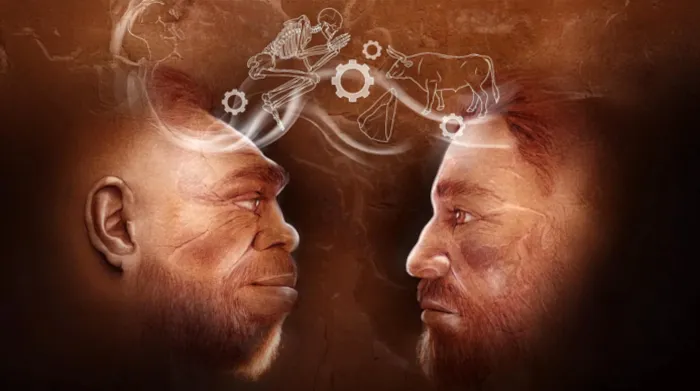
Recent archaeological findings at Tinshemet Cave in Israel and Goyet Caves in Belgium have shed light on the interactions between Neanderthals and Homo sapiens. These discoveries suggest that the two species not only coexisted but also actively engaged with one another, sharing technology and cultural practices.
Evidence from Tinshemet Cave indicates that Neanderthals and Homo sapiens developed similar burial practices, with formal burials appearing in Israel around 110,000 years ago. This suggests organized rituals among both groups, reflecting a shared understanding of death and possibly beliefs in an afterlife. Professor Yossi Zaidner remarked, “Our data show that human connections and population interactions have been fundamental in driving cultural and technological innovations throughout history.”
In contrast, findings from the Goyet Caves reveal a darker aspect of Neanderthal behavior. Analysis of bones indicates that Neanderthals selectively hunted and consumed outsiders, particularly women and children. The remains found in these caves date back to between 41,000 and 45,000 years ago, during the final millennia of Neanderthal existence in Europe. The deliberate targeting of outsiders suggests organized intergroup violence, a behavior that complicates the perception of Neanderthals as merely primitive beings.
DNA analysis from the Goyet Caves further supports these findings, revealing that the victims of cannibalism did not belong to the local Neanderthal group. This raises questions about the social dynamics and territorial behaviors of Neanderthals, indicating that their interactions with other groups were complex and potentially hostile.
Neanderthals are estimated to have gone extinct over 300,000 years ago, yet their legacy persists in modern non-African populations, which possess 2 to 5 percent Neanderthal DNA. This interbreeding highlights the intricate relationships between early human species and suggests that Neanderthals contributed to the genetic makeup of contemporary humans.
Moreover, the Levant region, where these interactions took place, is recognized as a crucial crossroads for human migration out of Africa. The presence of mineral pigments, particularly red ochre, found in both Neanderthal and Homo sapiens sites suggests that these groups shared not only tools but also cultural expressions and possibly beliefs.
As research continues, the complexity of Neanderthal and Homo sapiens interactions becomes increasingly evident. Martina Lake, a researcher in the field, stated, “This discovery shows that Neanderthals were more intelligent and complex than we thought.” Such findings challenge long-held assumptions about the capabilities and behaviors of Neanderthals, prompting a reevaluation of their role in human history.
Overall, these discoveries at Tinshemet and Goyet Caves provide invaluable insights into the lives of Neanderthals and their interactions with Homo sapiens, illustrating a shared history that is both rich and multifaceted. As more evidence emerges, the narrative of human evolution continues to evolve, revealing deeper connections among our ancient ancestors.