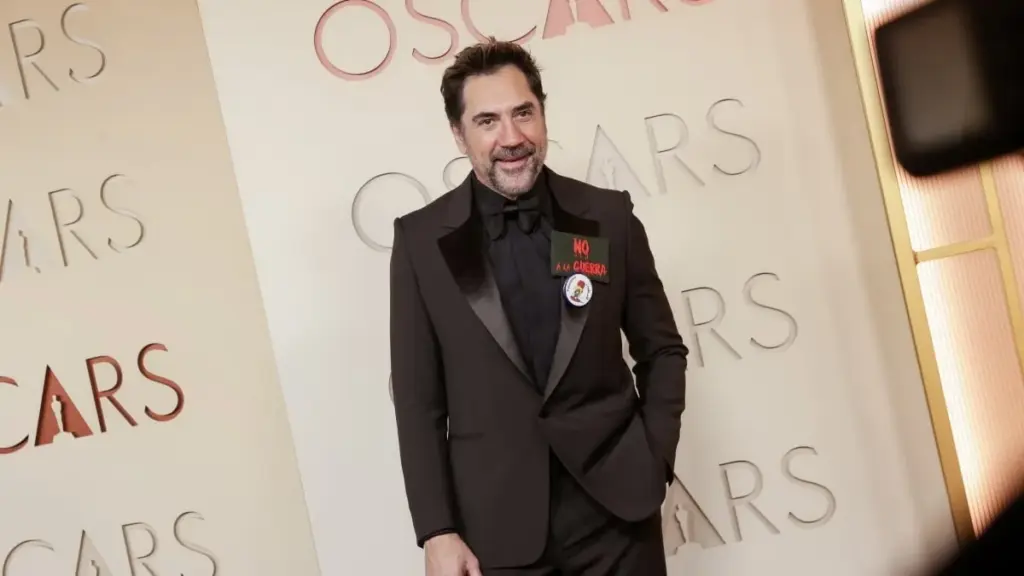
“No to war and free Palestine,” declared Javier Bardem during the 98th Academy Awards held in Los Angeles, California, on March 16, 2026. This statement marked Bardem’s most overtly political moment at the Oscars, as he wore a pin with the phrase “No a la guerra” to signify his stance against war.
Bardem’s choice to wear the pin was not new; he had previously donned the same accessory at the Oscars in 2003 to protest the Iraq war, which he described as an illegal conflict. He emphasized the importance of using the platform of the Oscars to voice opposition to wars that lead to significant loss of life.
“[The Oscars] is a great opportunity to say things like ‘no to war, no to this illegal war that [is] creating so many deaths,'” Bardem stated, highlighting the urgency of his message amid the ongoing violence in Gaza. His remarks came at a time when the conflict in the Middle East has escalated, with reports indicating that over 72,000 Palestinians have been killed and 172,000 wounded since the onset of hostilities in October 2023.
In his condemnation, Bardem specifically criticized former President Trump and Israeli Prime Minister Netanyahu for their roles in perpetuating what he termed another illegal war. His comments resonated deeply with the audience, reflecting a growing concern over the humanitarian crisis unfolding in Gaza, where 90% of civilian infrastructure has reportedly been destroyed.
The backdrop of Bardem’s statement is significant, as Israel’s military actions in Gaza have been described by many as genocidal, leading to widespread international outcry. Bardem’s call for peace and justice for Palestine has sparked discussions about the responsibilities of public figures in addressing global issues.
As the world continues to grapple with the consequences of the conflict, Bardem’s bold stance at the Oscars serves as a reminder of the power of celebrity voices in advocating for change. The event not only celebrated cinematic achievements but also highlighted pressing humanitarian issues that demand attention.
With the situation in Gaza still critical, Bardem’s statement is expected to keep the conversation about the conflict alive in the public sphere. Activists and supporters of Palestinian rights are likely to rally around his message, urging for a peaceful resolution to the ongoing violence.
As the aftermath of the Oscars unfolds, it remains to be seen how Bardem’s remarks will influence public opinion and political discourse surrounding the Israeli-Palestinian conflict.