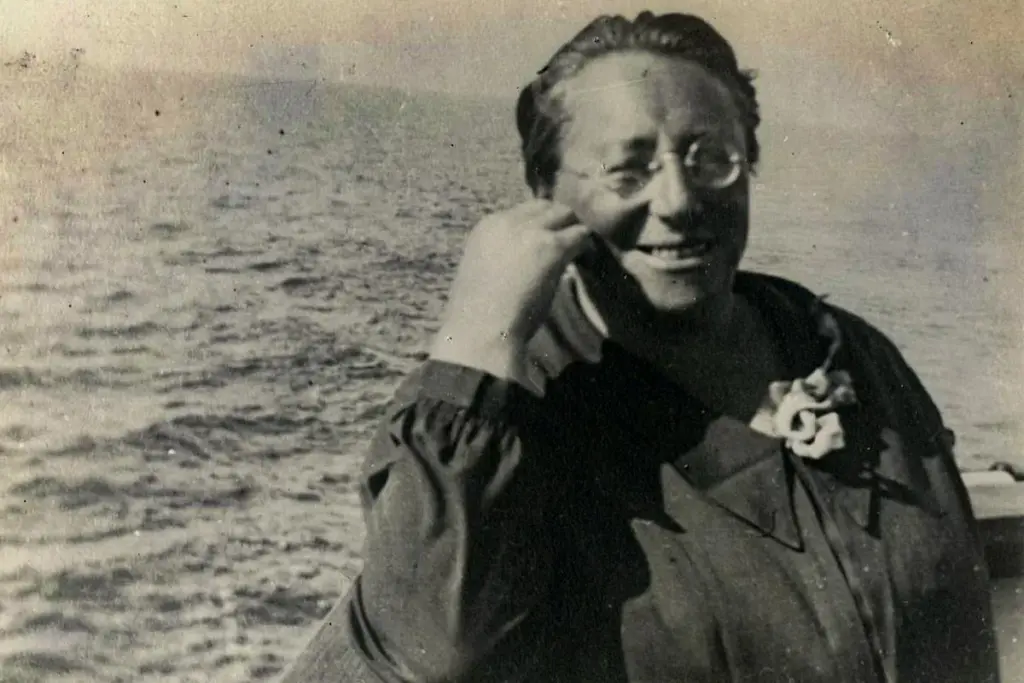
Emmy Noether was a German mathematician in the early 20th century, renowned for her groundbreaking contributions to mathematics and physics. Despite her exceptional talent, Noether faced significant gender discrimination throughout her academic career, including being barred from formal teaching positions. In 1900, she was forbidden to enroll in university courses due to her gender, a barrier that would define much of her early academic journey.
Noether eventually received a PhD in mathematics in 1907, but she was not eligible for habilitation, which was required for paid academic work. This left her in a precarious position, spending eight years teaching students at her father’s institution without a salary and an additional four unpaid years at the University of Göttingen. During this time, she developed her influential theorems that would later reshape the understanding of physics.
In 1917, Noether presented her first theorem, which linked conservation of energy and other quantities to the independence of variables such as time, space, and direction. This was followed by her second theorem in 1918, which explained conservation of energy in unbound situations, particularly in the context of relativity theory. Her work laid the foundation for modern algebra and has been recognized as pivotal in the development of theoretical physics.
Despite her achievements, Noether’s journey was fraught with challenges. She was often seen as an anomaly, described by some as “a male mind trapped inside a female body.” This perception, while highlighting her exceptional intellect, also underscored the societal barriers she faced. Albert Einstein, a contemporary and admirer, praised her abilities, stating, “It would have done no harm to the troops returning to Göttingen from the field if they had been sent to school under Fräulein Noether.” Such endorsements were rare for women in academia at the time.
In 1933, as the Nazis rose to power and prohibited Jews from academic work, Noether fled Germany for the United States. Initially reluctant to teach at Bryn Mawr College, she eventually embraced her female students as friends and protégées, fostering a supportive environment for women in mathematics. Her legacy continues to inspire generations of mathematicians and physicists, emphasizing the importance of diversity in academia.
Noether’s contributions to mathematics and physics have been recognized posthumously, with her theorems being foundational in various fields. Her first theorem is often regarded as a key to unlocking the doors that other mathematicians had kicked open, a sentiment echoed by her contemporary Hermann Weyl, who remarked on the significance of her methods.
Today, Emmy Noether is celebrated not only for her mathematical genius but also for her role in challenging the gender norms of her time. Her story serves as a reminder of the barriers that women have faced in academia and the importance of perseverance in the pursuit of knowledge. As observers reflect on her legacy, it is clear that her impact on mathematics and physics will endure for generations to come.