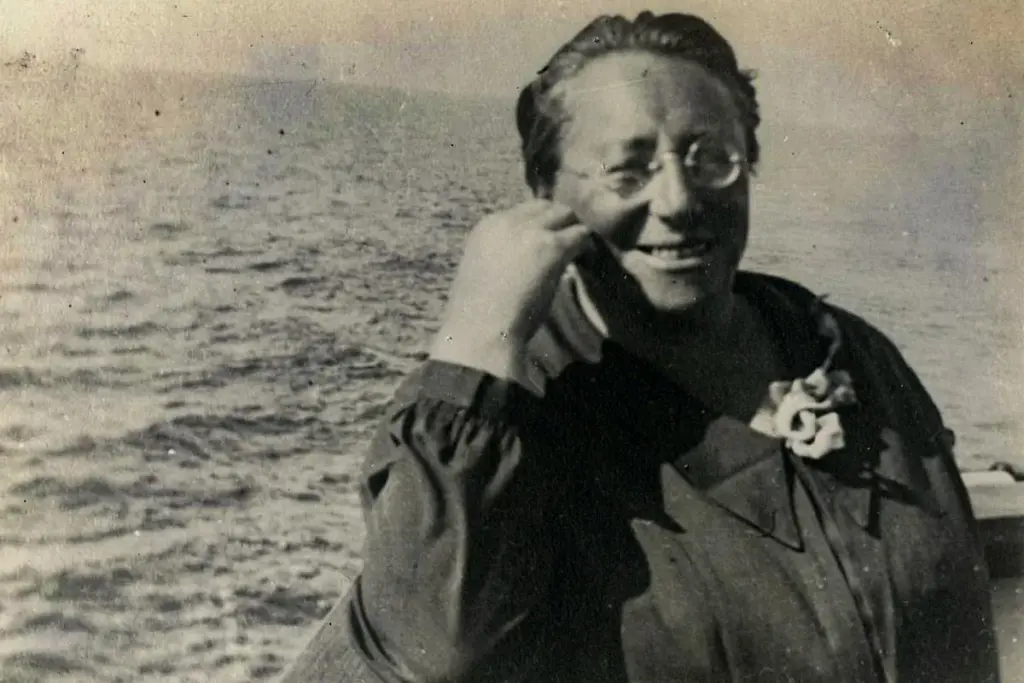
Emmy Noether was a German mathematician in the early 20th century, known for her groundbreaking contributions to mathematics and physics. Despite her exceptional talent, Noether faced significant gender discrimination throughout her academic career. She was forbidden to enroll in university courses in 1900 due to her gender, and even after receiving her PhD in mathematics in 1907, she was not eligible for habilitation, which was required for paid academic work.
In 1919, Noether habilitated and began teaching at the University of Göttingen, where she became a prominent figure in the academic community. Her work, particularly Noether’s theorems, deals with the mathematical conditions of reality, notably the timelessness of the laws of physics. The first theorem links conservation of energy to independence of time and space, while her second theorem explains conservation of energy in unbound situations, such as those in relativity theory.
Noether’s contributions were not fully recognized during her lifetime, and she gained significant recognition posthumously. Albert Einstein praised her work, stating, “It would have done no harm to the troops returning to Göttingen from the field if they had been sent to school under Fräulein Noether.” This reflects the high regard in which she was held by her contemporaries.
Throughout her career, Noether struggled to attain a formal research position or salary, often being seen as an exception in a male-dominated field. She was described as “a male mind trapped inside a female body,” highlighting the challenges she faced as a woman in academia. Her friends and colleagues even gave her the nickname ‘Der Noether’, using the masculine article ‘der’ to characterize her as neither Mr nor Miss.
In 1933, with the rise of the Nazis and their policies against Jews, Noether fled Germany for the United States. She continued her work in mathematics and helped establish a new branch known as modern algebra. Despite the obstacles she faced, Noether’s legacy endures, and her theorems remain fundamental in both mathematics and physics.
As observers reflect on her contributions, it is clear that Noether’s work has had a lasting impact on the fields of mathematics and physics. Her story serves as a reminder of the importance of diversity and inclusion in academia, and the need to recognize the contributions of those who have been historically marginalized.