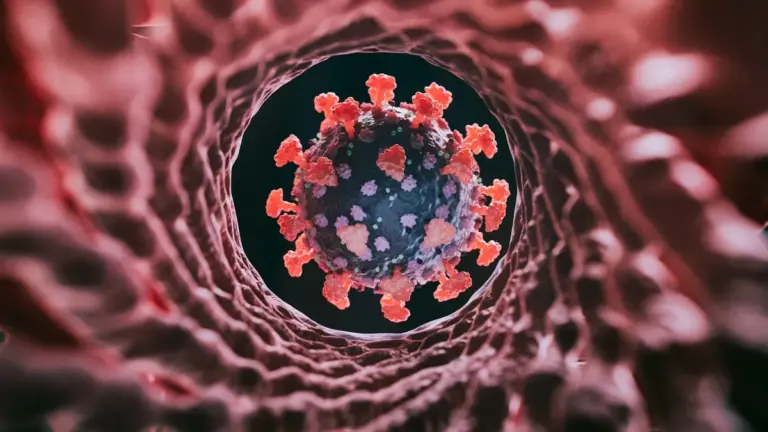
The BA.3.2 variant of COVID-19 was first identified in South Africa in November 2024 and has since spread to at least 23 countries, including 25 states in the United States. This variant is notable for carrying approximately 70-75 mutations in the spike protein, raising concerns among health officials.
Experts believe that BA.3.2 may partially evade immunity from prior infections or current vaccines. Symptoms associated with this variant include sore throat, cough, congestion, fatigue, headache, fever, nausea, and diarrhea.
Brandon Dionne, a health expert, stated, “There definitely are quite a few mutations with this one, so there’s concern that the current vaccine is not going to be a great match.” Despite these concerns, Andrew Pekosz noted, “It looks scary on paper, but it hasn’t really made a big impact in terms of disease in most places yet.”
In the U.S., the variant was first detected in June 2025, and current vaccines are expected to provide some level of protection against it, according to Dr. Adolfo García-Sastre, who remarked, “It’s not completely clear how effective the current vaccine will be, but it likely still has some effectiveness.” Meanwhile, Neil Maniar emphasized the importance of protecting higher-risk individuals and continuing standard precautions.
Currently, COVID-19 is still causing significant mortality, with estimates of 300-500 deaths per week linked to the virus in the U.S. Additionally, 11 percent of wastewater samples have tested positive for BA.3.2, indicating its presence in the community.
BA.3.2 is a descendent of BA.3, an omicron subvariant that emerged in 2022. As the situation evolves, uncertainties remain regarding the exact prevalence of BA.3.2 in the U.S. due to reduced surveillance and how the variant may evolve or potentially cause a surge in cases. Details remain unconfirmed.