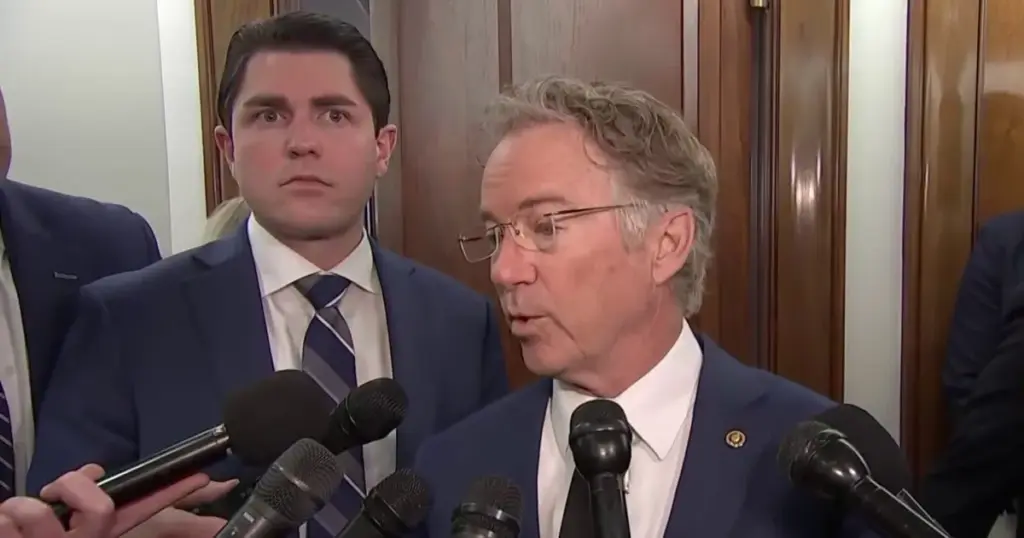
Rand Paul, the chairman of the Senate Committee on Homeland Security, has announced his opposition to Markwayne Mullin’s nomination to lead the Department of Homeland Security. This decision comes amid ongoing discussions about political violence and its implications for leadership roles in government.
In 2017, Rand Paul was assaulted by a neighbor, resulting in six broken ribs. This personal experience has shaped his views on political violence, making the current confirmation hearing particularly significant for him.
During the confirmation hearing, Paul confronted Mullin regarding his previous comments that seemed to condone violence, questioning his stance on political violence. Mullin, in response, stated, “I don’t always agree with that. I don’t believe in political violence. I’ve made that very clear.”
However, Mullin also referred to Paul’s inquiries as “character assassination,” suggesting that the questioning was more about personal attacks than legitimate concerns over policy.
Adding to the complexity, Mullin mentioned that there is historical precedence for violence in politics, citing practices such as caning and dueling to resolve disputes between lawmakers. This remark has raised eyebrows among those who view such references as inappropriate in today’s political climate.
Paul’s firm stance against Mullin’s nomination was clear when he stated, “I’ll be a no,” indicating that he would not support Mullin’s confirmation.
The implications of this opposition are significant, as it highlights the ongoing debate about political violence and its acceptance in political discourse. Observers are closely monitoring how this situation will unfold, particularly in light of the upcoming votes in the Senate.
As the confirmation process continues, it remains to be seen how other senators will respond to Paul’s concerns and whether Mullin’s nomination will ultimately be successful.
Details remain unconfirmed regarding the potential impact of this opposition on future nominations and the broader conversation about political violence in the United States.