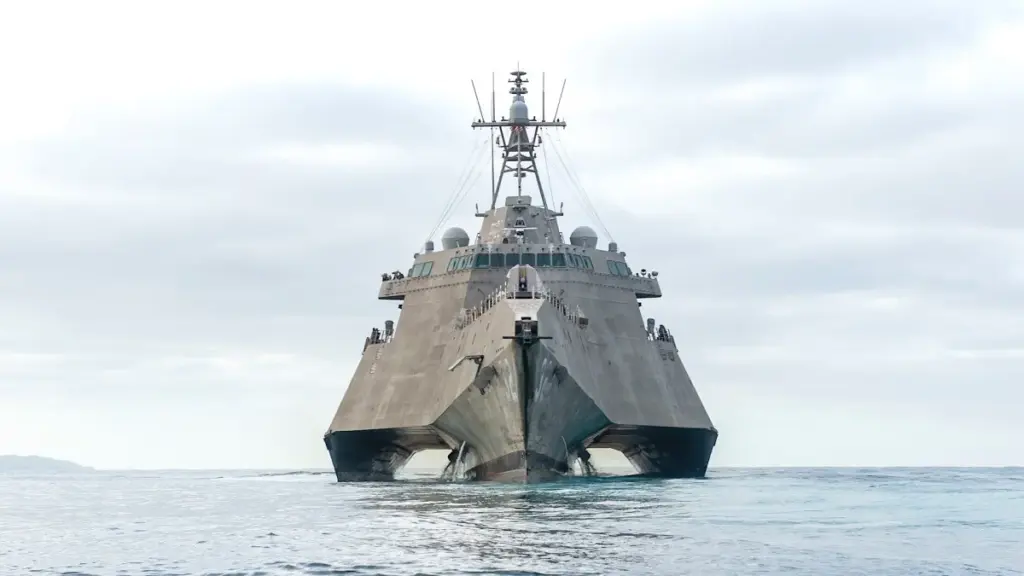
The U.S. Navy has deployed two Independence class Littoral Combat Ships, the USS Tulsa and USS Santa Barbara, to Malaysia amid rising tensions in the region, particularly concerning Iranian attacks on commercial vessels in the Strait of Hormuz. Both ships were previously forward-deployed in the Middle East and are now spotted at the North Butterworth Container Terminal in the Port of Penang.
These vessels were assigned to mine-countermeasure missions in the Persian Gulf, highlighting their critical role in ensuring maritime security. U.S. Navy Commander Joe Hontz confirmed that the ships are conducting brief logistical stops in Malaysia, although the exact reasons for their relocation remain unclear.
The deployment comes as the U.S. military has intensified efforts to target mine-laying assets in the region, a response to the increasing threat posed by Iranian naval activities. The scale of naval mining in the strait remains unclear, but any mines laid in the waterway would pose a serious threat to shipping.
The U.S. Navy’s Fifth Fleet, headquartered in Manama, Bahrain, has been actively monitoring the situation. The deployment of the USS Tulsa and USS Santa Barbara is part of a broader strategy to enhance naval presence in the area, especially following the decommissioning of the Avenger class mine hunters that were previously utilized for such missions.
With only four Avenger class ships remaining in active service, all currently forward-deployed in Japan, the Navy’s transition to LCSs configured for mine countermeasures is significant. The Independence class ships are equipped with advanced mine detection and neutralization systems, including those carried by MH-60 Sea Hawk helicopters.
Details remain unconfirmed regarding whether any additional mine countermeasures ships are on the way to the Middle East. Observers are closely watching the situation, particularly the current disposition of the USS Canberra, whose location is currently unknown.