What Happened
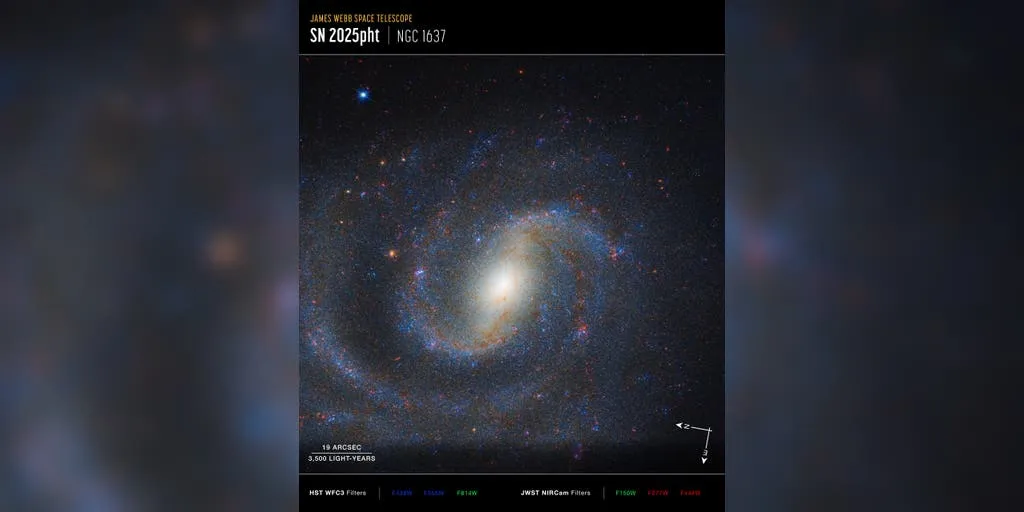
A team of astronomers from Northwestern University has utilized NASA’s James Webb Space Telescope (JWST) to uncover significant findings regarding a supernova that occurred over 40 million years ago in a nearby galaxy. The explosion, which sent material across space, produced a beacon of light that reached Earth on June 29, 2025. Initially thought to be a new supernova, the researchers compared JWST images with archival data from the Hubble Space Telescope, revealing the ancestral star responsible for the explosion.
Why It Matters
This discovery is pivotal as it marks the first time astronomers have observed a supernova in a galaxy previously studied by JWST. Lead author Charlie Kilpatrick noted the importance of this event, stating, “We’ve been waiting for this to happen, for a supernova to explode in a galaxy that Webb had already observed.” The findings also highlight the characteristics of the red supergiant star involved, which is described as the “reddest, most dusty red supergiant” seen to date.
What’s Next
Following this discovery, astronomers plan to further analyze the data collected by JWST to gain deeper insights into the nature of supernovae and their progenitor stars. The ongoing research will contribute to a better understanding of stellar evolution and the life cycles of stars in our universe.